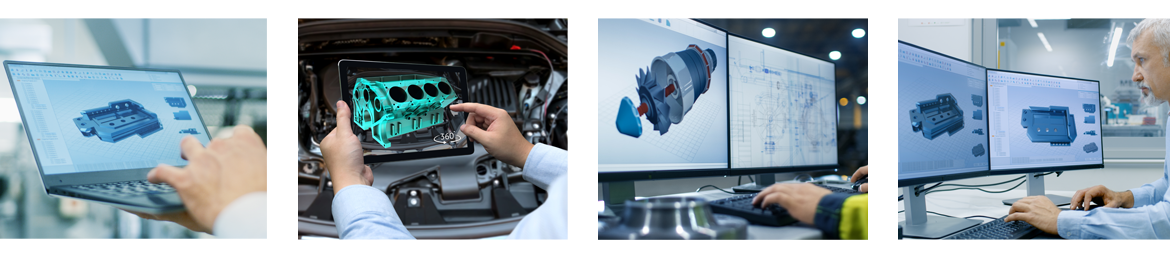
The automotive industry is characterized by constant evolution. Rapid technological advancements, shifting consumer expectations, and stringent regulatory norms continue to redefine how vehicles are conceived, designed, and manufactured. To remain competitive, automotive manufacturers must continuously adapt their development and production processes through forward-looking measures - spanning technical innovation, aesthetic design, and operational efficiency.
Vehicle development today involves an array of intricate tests, prototype iterations, and validation procedures that assess performance, safety, manufacturability, and environmental compliance. Fortunately, the rise of digital technologies has transformed these traditionally labour-intensive phases into agile, data-driven workflows. Sophisticated engineering software has emerged as a key enabler, helping engineers model real-world behaviours, explore creative solutions, and shorten the product development timeline.
Broadly, automotive product development integrates three major domains: design, engineering, and production. Computer-Aided Design (CAD) plays a pivotal role within this triad. It involves using computer systems to create, modify, analyze, and optimize the design of every vehicle component—from the smallest bracket to complete body assemblies. Computer-Aided Engineering (CAE) complements this by enabling analytical simulations such as finite element analysis (FEA), computational fluid dynamics (CFD), and multibody dynamics (MBD), while Computer-Aided Manufacturing (CAM) transforms validated designs into production-ready formats. Among these, CAD forms the foundation, providing precise digital representations that integrate across all subsequent phases.
In modern automotive development, CAD is indispensable. It streamlines collaboration between designers, engineers, and manufacturers and bridges diverse domains such as structural design, aerodynamics, ergonomics, and durability studies. Moreover, CAD automation has opened avenues for optimization and innovation at a speed previously unattainable through manual drafting. This article explores how CAD tools address the complex challenges of automotive component design and how leading engineering services companies leverage them to accelerate product innovation.
Designing automotive components is not merely about giving a vehicle its visual form - it is about achieving the perfect synthesis of functionality, strength, manufacturability, aesthetics, and cost efficiency. Several challenges typically arise during this process.
- Geometrical complexity and definition: Automotive components often demand high precision and complex geometrical relationships. Even minor inconsistencies can lead to interference during assembly or degrade performance. With components needing to fit within tight packaging spaces, defining accurate tolerances and maintaining design intent across multiple iterations become critical challenges.
- Lightweighting and material optimization: Modern vehicles must deliver high performance while remaining fuel-efficient and compliant with environmental regulations. Lightweighting has therefore become a core engineering priority. Designers must explore materials such as aluminium alloys, composite structures, and high-strength steels that can reduce weight without compromising stiffness, crashworthiness, or cost.
- Structural and shape optimization: Every vehicle component - from suspension arms to engine mounts - must balance load-bearing strength with minimal mass. Structural optimization seeks the most efficient distribution of material, while shape optimization deals with contours and surfaces that affect aerodynamics and aesthetics. Achieving both simultaneously demands advanced iterative modelling and analysis.
- Material compatibility and manufacturability: As new materials emerge, so do fabrication and integration challenges. Different parts of the vehicle may use different materials requiring unique joining technologies. Ensuring manufacturability - while maintaining performance targets and aesthetic quality - calls for precise modelling and predictive simulation.
- Time-to-market pressures: Global competition compels automakers to shorten product lifecycles and deliver new models faster. The ability to refine multiple design variations within limited timeframes has become critical. Manual design workflows often cannot keep pace with these accelerating demands.
- Increasing interdisciplinary collaboration: Designing modern automotive systems involves coordination among mechanical, electrical, thermal, and electronic engineers. Misalignment between disciplines can lead to costly redesigns and delays if integration is not handled efficiently.
How CAD Addresses These Challenges
CAD technology directly addresses these challenges by providing a unified digital environment where creativity meets precision. It allows engineers and designers to conceptualize, simulate, and optimize every component in a controlled virtual space.- Precision in geometry and parametric design: CAD platforms allow parametric modelling, ensuring that every geometric change in one part automatically updates related components or assemblies. This eliminates rework when modifications occur and ensures all design data stay consistent across the development pipeline.
- Lightweighting through digital prototyping: By combining CAD with associated analysis tools, engineers can experiment with different geometries and materials to minimize weight while keeping performance intact. For instance, vehicle body panels can be digitally optimized for minimal thickness yet sufficient rigidity before any physical prototype is built.
- Integrated optimization workflows: CAD integrates seamlessly with CAE and CAM environments, enabling virtual testing of component structures under real-life stress conditions. Shape optimization algorithms within CAD systems can analyze aerodynamic flow, surface curvature, and load distribution, helping designers find optimal forms quickly and efficiently.
- Improved manufacturability and assembly validation: CAD models can be analyzed for interference checks, tolerancing, and collision detection before production begins. This helps ensure components not only function as intended but also fit seamlessly within the overall vehicle architecture. These early validations drastically reduce the number of physical prototypes required.
- Enhanced collaboration across teams: Cloud-based CAD databases and version control enable multiple teams - across geographies and disciplines - to work on the same model simultaneously. This fosters cross-functional design synergy and accelerates review cycles.
- Accelerated iteration cycles: Automated design templates, libraries, and configurators allow engineers to generate multiple variants of a part almost instantly, supporting faster decision-making.
- Integration with sustainability and compliance goals: CAD’s ability to digitally simulate material usage and lifecycle impact also helps manufacturers align with sustainability targets and environmental standards.
In essence, CAD tools transform the traditional design process into a data-driven engineering ecosystem, where every modification contributes to measurable performance and manufacturing efficiency.
For many automotive manufacturers, maintaining in-house CAD expertise and high-end computational resources can be costly and time-consuming. Engineering services companies bridge this gap by combining domain expertise, skilled professionals, and state-of-the-art CAD infrastructure to provide tailored design solutions.
These companies offer a full spectrum of services - from concept modelling and parametric design to simulation integration and design validation. Their engineers possess deep knowledge of materials, manufacturing processes, and optimization techniques, enabling them to translate conceptual sketches into production-ready models. Furthermore, with experience across multiple vehicle programs, they understand regulatory requirements, ergonomic standards, and safety norms in various global markets.
Partnering with an experienced engineering services firm allows automotive manufacturers to rapidly develop innovative components while minimizing risks during product development. For example, outsourcing CAD-based design of engine brackets or suspension modules can free the manufacturer’s internal resources for strategic activities such as vehicle platform integration or consumer-focused innovation.
Engineering services companies can bring advanced design concepts to life faster, reduce product development costs, and ensure their vehicles meet performance, safety, and aesthetic expectations in a highly dynamic global market. In an industry driven by innovation and speed, the right CAD partnerships are no longer optional - they are essential to maintaining leadership and shaping the vehicles of the future.